Timing the market vs. timing your life
Market timing is the weakest lever a homeowner controls. The hidden costs of waiting, the rate-price trade-off, and why readiness beats prediction.
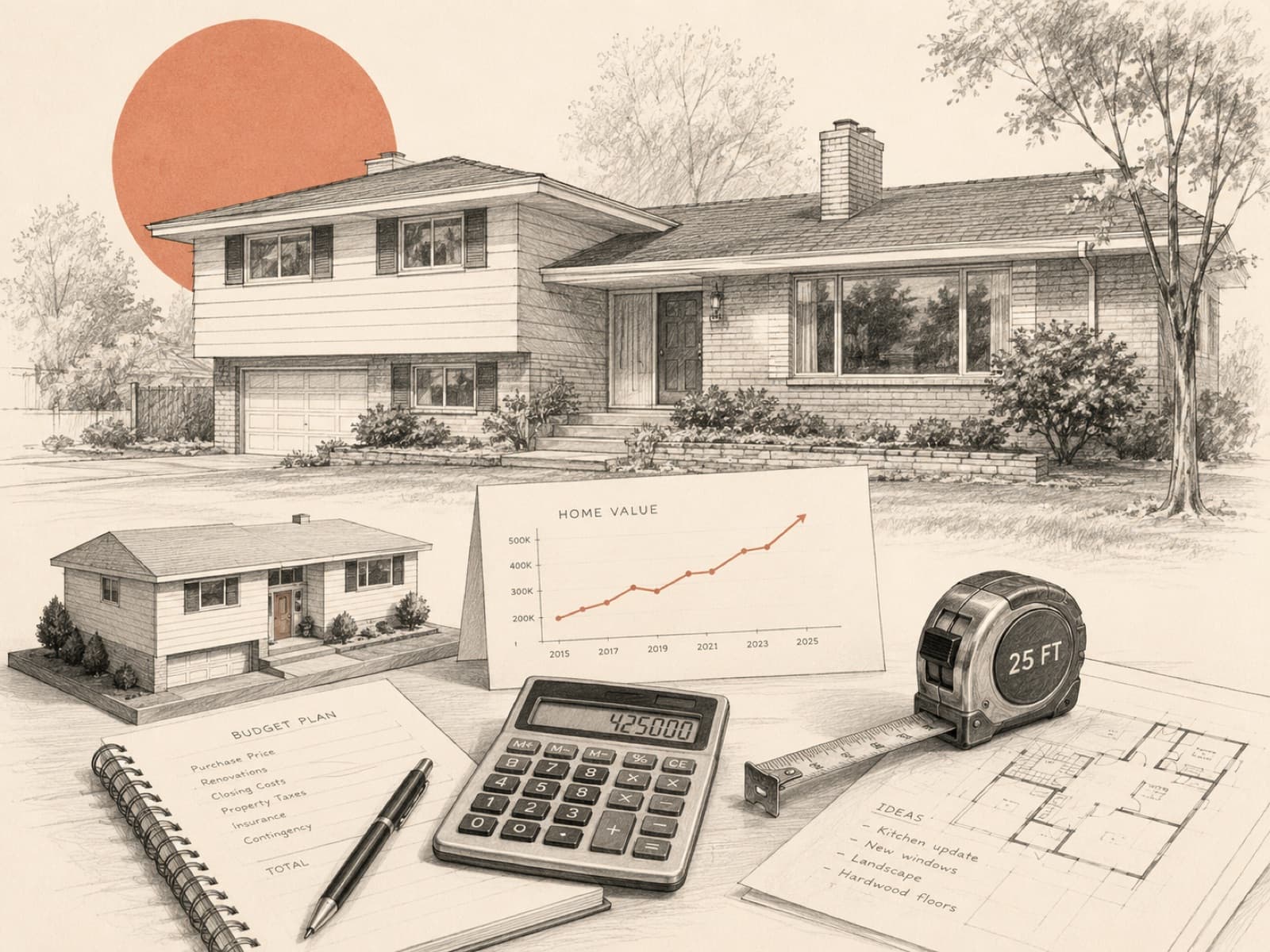
Every year has a chorus telling homeowners it's the moment to act — rates are about to move, inventory is about to shift, prices are about to do something. And every year, some homeowners postpone a sale, rush a purchase, or sit on a needed renovation, waiting for a market moment that arrives on no particular schedule.
Here's the calmer view: for most homeowners, market timing is the least powerful lever they control, attached to the decisions they control least. What the market does matters — but when you act on a home you live in is usually a life decision wearing a finance costume.
What the market actually moves
It helps to recall what determines your home's value: location sets a band, condition keeps you in it, improvements move you within it. The market is the fourth force — it shifts the entire band up or down, for every home around you at once.
That "at once" is the part timing strategies forget. If you sell into a hot market, you buy your next home in the same hot market. The gain on one side is largely spent on the other. Genuine timing wins mostly belong to people changing their relationship to the market itself — downsizing, relocating somewhere cheaper, or exiting ownership — not to people trading one home for a similar one across town.
Nobody calls turns — but everyone pays for waiting
Professional forecasters miss housing turns routinely, in both directions. The honest version of market prediction is a probability fan, not an arrow.
Meanwhile, waiting has quiet, certain costs that rarely make it into the mental math:
- Life cost. Two years in a home that doesn't fit — too small, too far, too many stairs — is a real price, paid daily, in the only currency you can't earn back.
- Carrying cost. Taxes, maintenance, and interest continue while you wait for a better moment.
- Aging cost. Homes don't pause while you do. Roofs and furnaces keep running their clocks, and deferred upkeep compounds regardless of what rates are doing.
Set the certain costs of waiting against the possible benefit of better timing, and the trade gets honest: you're paying known money for an unknown edge.
Rates, prices, and the trade nobody escapes
The modern version of timing anxiety is mostly about mortgage rates, and one asymmetry is worth knowing: the rate is renegotiable; the price is not. Buy at a high rate and you may refinance if rates fall. Overpay in a frenzy and that price is permanent.
But the deeper pattern is that rates and prices are linked. Cheap money historically pulls buyers in and pushes prices up; expensive money cools competition. Waiting for low rates usually means rejoining a stampede; the high-rate market that feels hostile is often the one with negotiating room. There is rarely a window where everything is favorable at once — which is exactly why the market's seasons matter less than yours.
Timing your life instead
The questions that should actually drive the act-now-or-wait decision are mostly not market questions:
- Horizon. Will you plausibly stay five to seven years? Transaction costs — agent fees, taxes, moving — consume several percent of a home's price, and a multi-year horizon is what amortizes them. Short horizons make any market risky; long horizons forgive almost every entry point.
- Stability. Income, family shape, location. Stable answers make this a fine time; unstable answers make even a great market a gamble.
- The payment, stress-tested. Not "can we qualify" but "does this payment leave room for the life we want, and survive a bad year?" A payment that only works if everything goes right doesn't work.
- The fit. Selling because the house no longer fits your life is a reason. Selling because a headline said the market peaked is a guess.
When those four line up, acting in an "imperfect" market beats waiting for a perfect one that can't be identified until it's past. When they don't line up, no market condition fixes that.
What homeowners can do about the market
For the home you're staying in, the market is weather — watch it, don't argue with it. But there is a useful posture: readiness over prediction.
You can't choose when the market peaks, when rates drop, or when life forces a move on you. You can choose to be the homeowner for whom acting is easy when the moment comes — whenever it comes:
- Know your home's honest condition, not your hopeful guess at it.
- Keep the maintenance clocks current, so a sudden sale doesn't start with a season of triage.
- Keep records of what's been done, so your home's story is evidence rather than assertion.
- Know your realistic value range — from real comparables, not a single screen number.
A prepared home can move on two months' notice and meet whatever market exists. An unprepared one negotiates from behind in any market. That preparation is the only timing edge reliably available to a homeowner — and conveniently, it's also just good ownership.